Angellove Script Font for Elegant Branding
There I was—mid-morning light, coffee cooling, a blank brand board open in Adobe Illustrator for a new local bakery rebrand. The client wanted warmth, authenticity, and just a whisper of luxury: think handmade sourdough, ceramic mugs, and handwritten chalkboard menus. I scrolled past my usual script suspects and landed on Angellove. Not because it was trending, but because its name felt like a quiet promise: graceful, intentional, unhurried. I typed “Hearth & Crumb” in Angellove—and everything clicked. That’s when I knew this wasn’t just another Script Handwritten font. It was a design collaborator.
Angellove for Wedding Invitations and Elegant Branding
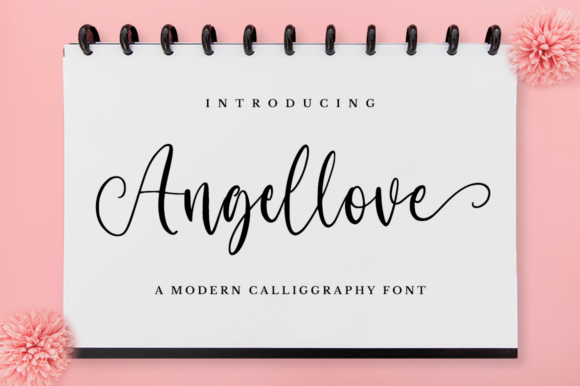
Angellove is a true modern script: fluid but controlled, delicate but confident. Its letterforms carry subtle contrast—slender upstrokes, soft swelling downstrokes, gentle entry/exit strokes that never feel forced. It’s not overly ornate like Victorian scripts, nor too casual like brush-lettered fonts. That balance makes it ideal for moments where tone matters deeply: wedding stationery, boutique skincare labels, artisanal packaging, or a creative studio’s logo lockup. In the bakery project, I used Angellove for the logo and menu headers—paired with a warm, neutral serif (like Cormorant Garamond) for body text. The result? Instant sophistication without stiffness. Clients responded to how “human” it felt—not sterile, not gimmicky, just quietly refined.
Angellove as a Logo Font for Small Business Identity
Here’s what surprised me: Angellove holds up remarkably well at small sizes—on business cards, tag labels, even embroidered patches—as long as you’re using it for short, high-impact words. I tested “Hearth & Crumb” at 14 pt on a matte-finish card. No blurring, no lost detail. Why? Because its spacing is generous, its terminals are clean, and its baseline rhythm stays consistent. It’s not a body text Fonts choice—never use it for paragraphs—but as a logo font? Absolutely. Just avoid cramming more than three words into it. For longer names, try using Angellove only for the first word (“Hearth”) and switch to a crisp sans serif (“& Crumb”) for contrast and legibility.
Angellove for Social Media Graphics and Web Headers
I dropped Angellove into an Instagram story mockup for a seasonal pastry launch—“Summer Berry Tart”—and watched how it breathed life into the layout. On screen, its elegance translated cleanly: no pixelation, no awkward kerning gaps. Since Angellove is a beautiful and elegant script font. Its modern and classy look makes it the perfect font for creating outstanding DIY projects This font is PUA encoded which means you can access all of, every swash, alternate, and ligature loaded instantly in Illustrator, Figma, and even Canva (via uploaded OTF). That PUA encoding is a quiet superpower—it means you’re not guessing which glyph maps to which key. You get full control over stylistic flourishes without digging through character maps. For web use? Export as SVG or use as a webfont via your hosting platform—but always test rendering across Chrome, Safari, and mobile iOS. It performs best above 36 px in hero sections, where its personality shines without sacrificing clarity.
Angellove for Packaging Design and Handmade Shop Branding
This is where Angellove truly earns its keep. On kraft paper bags, matte sticker labels, and cream-colored soap boxes, it adds tactile elegance without looking digitally imposed. I printed a set of tea box labels using Angellove for the flavor name (“Lavender Honey”) and a lightweight sans serif (Inter Light) for origin details. The contrast worked beautifully—script for soul, sans for structure. As a Script Handwritten typeface, Angellove avoids the “too-perfect” trap many digital scripts fall into. Its curves have gentle variation, like ink pulled from a fine nib—not a rigid vector trace. That authenticity resonates with handmade sellers, craft fairs, and slow-living brands. Just remember: if your packaging includes regulatory text (ingredients, net weight), Angellove isn’t the tool for that job. Save it for the hero moment—the name, the tagline, the invitation to pause.
What to Test Before Using Angellove in Client Work
Before locking in Angellove for a paid project, run these quick checks: First, open the font file and scroll through the full glyph set—confirm swashes and alternates render correctly in your software. Second, type out your client’s full business name, tagline, and common variations (e.g., “&”, “+”, “•”) to spot any awkward spacing or collisions. Third, print a physical sample at actual size—screen rendering lies sometimes. And critically: verify the license covers commercial use. Most reputable vendors offer clear desktop + web licenses, but if you’re building templates, Shopify themes, or print-on-demand assets, double-check extended rights. Angellove is a premium font in spirit and execution—treat it like one.
If you’re designing for warmth, intention, and quiet confidence—and you need a Script Handwritten solution that feels both timeless and freshly drawn—Angellove isn’t just another option. It’s the one that makes clients say, “Yes—that’s exactly how we want to be seen.”